
How Long Does Cavity Filling Actually Take (Step by Step)
- Vaibhav Sharma

- Dec 31, 2025
- 10 min read
Finding out you have a cavity is never the news you want to hear at the dentist’s office. Immediately following the diagnosis, a common wave of questions floods the mind: Will it hurt? How much will it cost? And, perhaps most pressing for those with busy schedules or dental anxiety: How long will I be in the chair?
We understand that time is a significant factor in your healthcare decisions. Whether you are squeezing an appointment into a lunch break, arranging childcare, or simply trying to mentally prepare yourself for the procedure, knowing the time commitment is essential for your peace of mind.
The short answer is comforting: most dental fillings are routine procedures that are completed relatively quickly. Generally, a simple filling takes about 20 minutes to one hour. However, this timeframe can fluctuate based on the tooth's location, the size of the decay, and the materials used.
In this comprehensive guide, we will break down exactly how long a cavity filling actually takes, moving through the process step-by-step so you know exactly what to expect from the moment you sit in the chair to the moment you leave.
How Long Does Cavity Filling Actually Take on Average?

When patients ask, "How long does cavity filling actually take?" they are usually looking for a specific number to plan their day. While every mouth is unique, we can provide reliable averages based on standard dental practices.
For a single, uncomplicated cavity, you can expect to be in the dental chair for approximately 45 minutes to one hour.
It is important to note that this duration is not solely "drilling time." This hour includes:
Reviewing your medical history and current X-rays.
Discussing the procedure and answering your questions.
Administering anesthesia and waiting for it to take effect.
The actual removal of decay and placement of the filling.
Checking your bite and polishing the tooth.
If you have multiple cavities that need to be addressed in the same quadrant (quarter) of your mouth, the dentist can often treat them in a single visit. This is more time-efficient than separate appointments because the setup and numbing process only happen once. In these cases, the appointment might last anywhere from 60 to 90 minutes.
Conversely, very small surface cavities (incipient lesions) that may not require anesthetic can sometimes be treated in as little as 20 to 30 minutes.
Understanding these averages helps reduce anxiety. The procedure is efficient, standardized, and designed to get you back to your daily routine as quickly as possible.
How Long Does Cavity Filling Actually Take Step by Step?

To truly understand where the time goes, it helps to visualize the appointment flow. Transparency is the antidote to anxiety. Here is a detailed breakdown of the timeline so you can see how long cavity filling actually takes during each phase of the visit.
Step 1: Dental Examination and Review (5–10 Minutes)
Before any instruments are touched, your dentist or dental hygienist will ensure you are comfortable. They will review your chart, check your blood pressure (standard in many practices), and confirm the tooth causing the issue. They may apply a topical numbing gel to your gum tissue at this stage to prepare for the local anesthetic.
Step 2: X-rays (5–10 Minutes, if needed)
If you haven't had recent X-rays (radiographs), the dentist may need a fresh image to see the depth of the decay between the teeth. Digital X-rays are instantaneous, but positioning the sensor and taking the image takes a few minutes. If you had X-rays at your diagnostic exam recently, this step is skipped, saving time.
Step 3: Local Anesthesia (10–15 Minutes)
This is often the part of the procedure that requires the most patience. After the dentist administers the local anesthetic (like lidocaine), they cannot start working immediately. The medication needs time to infiltrate the nerve and block sensation completely.
The Injection: Takes about 1–2 minutes.
The Wait: The dentist will likely leave the room or chat with you for 5–10 minutes while the numbness sets in. They will test the area to ensure you feel absolutely no pain before proceeding.
Step 4: Removing the Decay (10–15 Minutes)
Once you are fully numb, the dentist uses specialized instruments to remove the decayed portion of the tooth.
You will hear high-pitched sounds and feel vibration and water spray, but you should not feel pain.
The time this takes depends heavily on the extent of the rot. The dentist must reach hard, healthy tooth structure to ensure the filling bonds correctly and the decay does not spread further under the new restoration.
Step 5: Cleaning and Preparing the Cavity (2–5 Minutes)
After the decay is removed, the remaining void must be sterilized. The dentist will wash away debris and dry the area. If the cavity is deep (near the nerve), they may apply a protective liner or base to prevent sensitivity. For composite (white) fillings, an acid etch gel is applied for a few seconds to roughen the surface slightly, ensuring a strong bond.
Step 6: Filling Placement (10–20 Minutes)
This is where the technique varies by material (discussed further below).
Composite Fillings: These are applied in layers. The dentist places a layer of resin, then uses a special blue curing light to harden it instantly. This process is repeated until the tooth is built back up to its natural shape.
Amalgam Fillings: The silver material is packed into the space and carved into shape before it sets.
Step 7: Polishing and Bite Adjustment (5–10 Minutes)
The final step is crucial for comfort. The dentist will ask you to bite down on a piece of carbon paper. This marks "high spots" where the filling might be hitting the opposing tooth too hard. The dentist will smooth these down and polish the tooth so it feels smooth to your tongue.
Total Estimated Chair Time: 45–60 Minutes.
How Long Does Cavity Filling Actually Take Based on Cavity Size?

Not all cavities are created equal. The severity of the decay is the single biggest variable in determining how long cavity filling actually takes.
Small Cavities (One Surface)
A "Class I" or small surface cavity usually occurs on the chewing surface of a molar. Because the decay has not penetrated deeply into the dentin and is easily accessible, these are the quickest to treat.
Time estimate: 20–30 minutes.
Anesthesia: Sometimes optional for very shallow decay, which drastically cuts down time.
Medium Cavities (Two to Three Surfaces)
These cavities often involve the spaces between the teeth (interproximal decay). To fix these, the dentist must use a matrix band—a small metal or plastic ring placed around the tooth to create a temporary wall. This allows them to build the filling shape correctly so you can floss between your teeth later. Setting up this matrix and contouring the filling properly adds time.
Time estimate: 45–60 minutes.
Complexity: Requires precise contact point creation to prevent food impaction.
Deep Cavities (Extensive Decay)
If a cavity is deep, approaching the pulp (nerve), the dentist must work very slowly and carefully to avoid exposing the nerve, which would necessitate a root canal. They may need to place a sedative medicament or a pulp cap layer before the filling.
Time estimate: 60+ minutes.
Risk: These appointments are longer because the dentist is prioritizing tooth preservation over speed.
How Long Does Cavity Filling Actually Take for Different Filling Types?

The material you and your dentist choose affects the duration of the appointment. When researching how long cavity filling actually takes, it is helpful to know what material is being placed.
Composite (Resin/White) Fillings
These are the most common fillings today due to their aesthetics. However, they are "technique sensitive." The tooth must be kept perfectly dry (often using a rubber dam or isolation system). The material must be applied in 2mm increments and cured with light between each layer.
Time Impact: Longer procedure due to layering and strict isolation requirements.
Amalgam (Silver) Fillings
While less common now, silver fillings are durable and moisture-tolerant. The material is packed into the hole all at once and carved.
Time Impact: Generally faster to place than composites because they don't require layering or absolute dryness.
Ceramic or Gold Fillings (Inlays/Onlays)
These are "indirect" fillings. They are not done in one go.
Visit 1 (Preparation): The dentist removes decay and takes a mold/scan of the tooth (45–60 minutes).
Lab Time: The filling is made outside the mouth (usually 1–2 weeks).
Visit 2 (Cementation): The custom filling is glued in (30–45 minutes).
Note: Some offices with CAD/CAM technology (CEREC) can do this in one long visit (approx. 2 hours).
Temporary Fillings
Used in emergencies or as a placeholder during root canal therapy. These materials are soft and easy to place.
Time Impact: Very fast, often less than 30 minutes total.
How Long Does Cavity Filling Actually Take With or Without Anesthesia?

The administration of local anesthesia is a fixed block of time in the procedure.
With Anesthesia
As mentioned, the "numbing phase" adds about 10–15 minutes to the appointment. However, it actually speeds up the drilling phase because the patient is comfortable, allowing the dentist to work efficiently without stopping due to patient sensitivity.
Without Anesthesia
Some patients ask to skip the shot for small cavities to save time and avoid the lingering fat lip feeling.
Time Impact: While you save the 10-minute wait for the drug to kick in, the actual procedure might take longer if you are sensitive. The dentist must drill in short bursts to manage the heat and sensation.
Recommendation: This is only viable for very shallow cavities affecting only the enamel. Once decay hits the dentin (the softer layer underneath), anesthesia is strongly recommended for your comfort.
So, when asking how long cavity filling actually takes, remember that opting for anesthesia usually results in a smoother, more predictable timeline, even if the initial wait feels slow.
How Long Does Cavity Filling Actually Take for Children vs Adults?
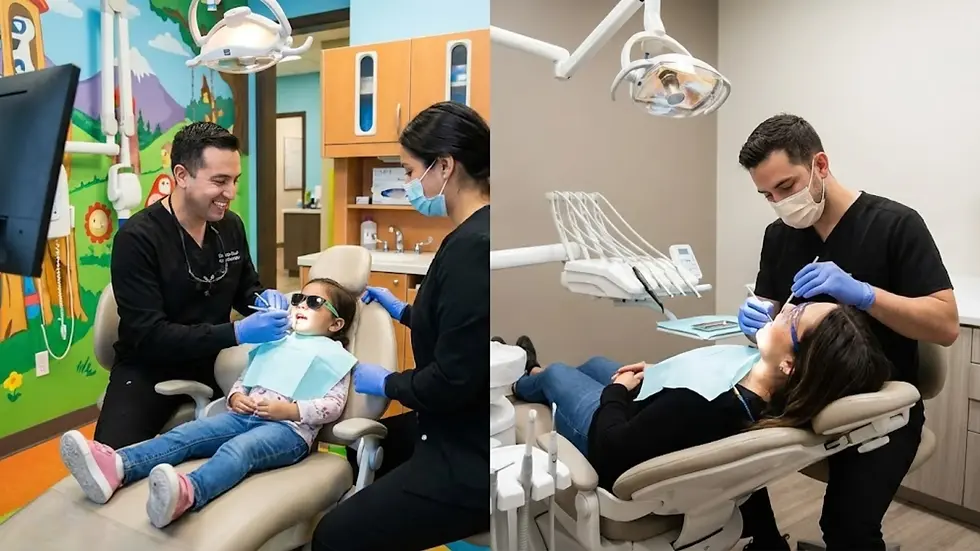
Pediatric dentistry operates on a different timeline than adult dentistry. The anatomy of primary (baby) teeth is different, and the temperament of the patient is a major factor.
Pediatric Considerations
Children generally have shorter attention spans and smaller mouths. Pediatric dentists are trained to work extremely fast.
The Procedure: A filling on a child might only take 20–30 minutes.
The "Total" Time: However, the appointment might block out 45 minutes to an hour. Why?
Tell-Show-Do: The dentist spends time explaining the tools to the child in non-scary terms ("Mr. Thirsty" for the suction, "Sleepy Juice" for anesthesia).
Behavior Management: Calming a nervous child takes time and patience.
Nitrous Oxide: If "laughing gas" is used, there is a setup time and a post-op oxygen flush time (about 5 minutes) to clear the gas from their system.
Adults
Adults can sit still, keep their mouths open wider, and follow instructions efficiently. This allows the dentist to focus purely on the technical work. However, adult teeth are larger and often have harder enamel, meaning the actual excavation of decay can take slightly longer than in soft baby teeth.
How Long Does Cavity Filling Actually Take Including Recovery Time?

The question "how long does cavity filling actually take" often extends beyond the dental chair. Patients want to know when they will feel normal again.
Numbness Duration
While the filling procedure ends when you stand up, the anesthesia lingers.
Upper Jaw: Numbness usually wears off in 1 to 2 hours.
Lower Jaw: The nerve block for lower teeth is more profound. You may feel numb for 2 to 4 hours post-procedure.
Eating Timeline
Composite Fillings: These are hardened instantly with the blue light. You can technically chew immediately after leaving the office. However, you should wait until the numbness wears off so you don't accidentally bite your cheek or tongue.
Amalgam Fillings: These take about 24 hours to fully harden. You should avoid chewing hard or sticky foods on that side for the first day.
Post-Op Sensitivity
It is normal to experience some sensitivity to cold or biting pressure for a few days to two weeks after the filling. This does not mean the procedure is still "taking place," but it is part of the biological healing process of the tooth nerve.
How Long Does Cavity Filling Actually Take If Multiple Teeth Are Involved?

If you have neglected your dental checkups for a while, you might require more than one filling. How does this affect the clock?
Same Appointment (Quadrant Dentistry)
Dentists prefer to treat all cavities in the same area (e.g., upper right side) at once.
Efficiency: You only get numb once. The setup is done once.
Time: Two fillings next to each other do not take double the time. If one filling takes 45 minutes, two might take 60 minutes. The preparation and filling steps can be done simultaneously across the teeth.
Multiple Visits
If you have cavities on both the left and right sides of your mouth, the dentist will likely split this into two appointments. Numbing the entire mouth at once can make it difficult to swallow or speak, and can be overwhelming for the patient. In this context, how long cavity filling actually takes is calculated across two separate days.
Conclusion

Understanding how long cavity filling actually takes can significantly reduce dental anxiety. For the vast majority of patients, you can expect to be in and out of the dental office in under an hour. It is a highly predictable, routine procedure designed to save your tooth and prevent more serious (and time-consuming) issues like root canals or extractions later on.
The 45 to 60 minutes you spend in the chair is a small investment for years of oral health. If you suspect you have a cavity, do not delay. The smaller the cavity, the faster and easier the appointment will be.
If you have specific time constraints or severe anxiety, discuss them with your dentist beforehand. They can often adjust the treatment plan or offer sedation options to make the time pass even more comfortably for you.
Frequently Asked Questions About How Long Does Cavity Filling Actually Take
Is cavity filling painful?
With modern local anesthesia, the procedure itself should be completely painless. You may feel pressure or vibration, but sharp pain is rare. If you feel anything, raise your hand, and the dentist can administer more anesthetic. The fear of pain often makes the time feel longer than it actually is.
Can I go back to work or school immediately after?
Yes. A cavity filling is a minor outpatient procedure. Most patients return to their daily activities immediately. The only lingering effect is the numbness/swollen feeling in the lip, which can make talking or smiling feel funny for a few hours.
Can a cavity filling take more than one visit?
Usually, no. Direct fillings (composite/amalgam) are "one-and-done." However, if the decay is so deep that the dentist needs to place a sedative dressing to see if the nerve heals before placing the permanent filling, you might need to return in a few weeks. This is called a "step-wise excavation."
How soon can I eat after a filling?
As mentioned, you can eat immediately with composite fillings, but it is medically advisable to wait until the anesthesia wears off to prevent soft tissue injury. Stick to a soft diet (smoothies, yogurt, soup) if you must eat while numb.
Does the needle hurt?
Dentists use a topical gel (a numbing jelly) on the gum before the injection. This significantly reduces the pinch. Most patients report that the anticipation is worse than the actual sensation.
Medical Disclaimer: The content provided in this blog post is for informational and educational purposes only. It is not intended to be a substitute for professional medical advice, diagnosis, or treatment. Always seek the advice of your dentist or other qualified health provider with any questions you may have regarding a medical condition or treatment. Never disregard professional medical advice or delay in seeking it because of something you have read on this website. Procedures and timeframes vary by individual case.
References
Centers for Disease Control and Prevention (CDC) – Oral Healthhttps://www.cdc.gov/oralhealth
PubMed – Clinical studies on dental restorationshttps://pubmed.ncbi.nlm.nih.gov
Healthy Children org - https://www.healthychildren.org/English/healthy-living/oral-health/Pages/Fluoride-Varnish-What-Parents-Need-to-Know.aspx
NHS Inform - https://www.nhsinform.scot/tests-and-treatments/dental-treatments/fluoride/


Comments