
What Is Extra Virgin Olive Oil and Why Is It Good for Your Health?
- Vaibhav Sharma

- Jan 12
- 7 min read
Often referred to as "liquid gold" by Homer and a staple of the diets of some of the world’s longest-living populations, olive oil is more than just a kitchen condiment; it is a nutritional powerhouse. However, not all olive oil is created equal. Standing at the top of the hierarchy is Extra Virgin Olive Oil (EVOO).
For decades, nutritional science has scrutinized the Mediterranean diet, consistently finding that its primary source of added fat—extra virgin olive oil—plays a pivotal role in chronic disease prevention. But amidst the marketing buzz and varying labels on supermarket shelves, confusion remains.
In this comprehensive guide, we will analyze exactly what is extra virgin olive oil, explore the biochemical mechanisms that explain why is extra virgin olive oil good for your health, and provide evidence-based guidelines on how to incorporate it into a balanced lifestyle.
What Is Extra Virgin Olive Oil? Understanding the Grade
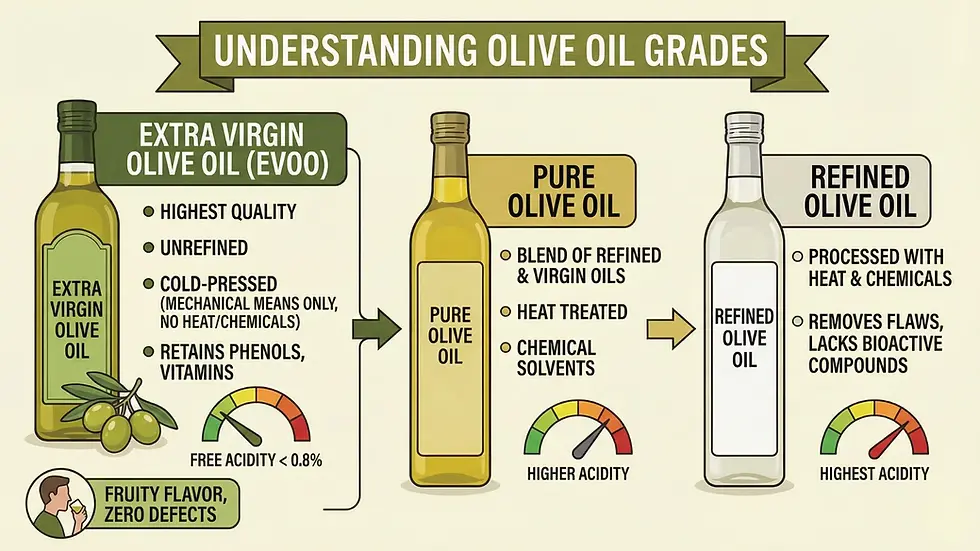
To understand the health potential, one must first understand the classification. Extra virgin olive oil is the highest quality olive oil available. It differs significantly from "pure" or "refined" olive oil in how it is processed and its chemical composition.
The Production Process
True EVOO is unrefined. It is simply the juice of the olive fruit ( Olea europaea), extracted solely by mechanical means (pressing or centrifugation) without the use of heat or chemical solvents. This "cold-pressed" method ensures that the oil retains its natural phenols, vitamins, and sensory characteristics.
Chemical Standards
For an oil to be classified as "extra virgin," it must meet strict chemical and organoleptic standards set by the International Olive Council (IOC):
Free Acidity: It must have a free acidity, expressed as oleic acid, of no more than 0.8 grams per 100 grams (0.8%). Lower acidity generally indicates higher quality fruit and faster processing.
Peroxide Value: A measure of oxidation; it must be low, indicating the oil is fresh and undamaged.
Sensory Defects: It must have zero organoleptic defects (like mustiness or rancidity) and possess some fruity flavor.
In contrast, regular "olive oil" is often a blend of refined oil (treated with heat and chemicals to remove flaws) and a small amount of virgin oil for flavor. These refined oils lack the potent bioactive compounds that make extra virgin olive oil a functional food.
Nutritional Profile of Extra Virgin Olive Oil

The health effects of EVOO are derived from its unique nutritional composition. It is 100% fat, but the type of fat and the accompanying micro-nutrients set it apart.
Breakdown per Tablespoon (approx. 14g)
Nutrient | Amount | % Daily Value (DV) |
Calories | 119 | - |
Total Fat | 13.5g | 17% |
Saturated Fat | 1.9g | 10% |
Monounsaturated Fat | 9.8g | - |
Polyunsaturated Fat | 1.4g | - |
Vitamin E | 1.9mg | 13% |
Vitamin K | 8.1mcg | 7% |
Carbohydrates | 0g | 0% |
Protein | 0g | 0% |
The Secret Weapon: Polyphenols
While the monounsaturated fats (mostly oleic acid) are crucial, researchers believe the true health driver is the phenolic content. EVOO contains over 30 different types of phenolic compounds, which act as powerful antioxidants. Key compounds include:
Oleocanthal: Mimics the anti-inflammatory effect of ibuprofen.
Oleuropein: Protects LDL cholesterol from oxidation.
Hydroxytyrosol: One of the most potent antioxidants found in nature.
Why Is Extra Virgin Olive Oil Good for Your Health? Evidence-Based Benefits

The scientific literature supporting the consumption of EVOO is vast. Below, we dissect the major clinical areas where extra virgin olive oil demonstrates significant efficacy.
1. Cardioprotection and Heart Health
Cardiovascular disease remains the leading cause of death globally. Observational studies consistently show that heart disease is less common in Mediterranean countries.
Mechanism: The high content of oleic acid (a monounsaturated fatty acid) helps modulate blood lipids. However, the polyphenols are equally important.
Blood Pressure: A study published in Clinical Nutrition found that regular consumption of polyphenol-rich olive oil reduced the need for blood pressure medication in elderly patients.
Endothelial Function: EVOO improves the lining of blood vessels (endothelium), which is critical for blood clotting regulation and vascular relaxation.
LDL Oxidation: It is not just about lowering "bad" LDL cholesterol, but preventing it from oxidizing. Oxidized LDL is what physically causes plaque buildup (atherosclerosis). The antioxidants in EVOO bind to LDL particles and protect them.
2. Potent Anti-Inflammatory Properties
Chronic inflammation is a leading driver of diseases such as cancer, heart disease, metabolic syndrome, type 2 diabetes, and arthritis.
Nature's Ibuprofen: A landmark study identified that oleocanthal, a phenol in EVOO, inhibits the same cyclooxygenase (COX) enzymes as ibuprofen. Scientists estimate that 50ml (about 3.5 tablespoons) of extra virgin olive oil has an effect similar to 10% of an adult ibuprofen dosage—enough to provide low-level, chronic anti-inflammatory benefits without the side effects of drugs.
C-Reactive Protein (CRP): Studies indicate that people who strictly follow a Mediterranean diet rich in olive oil have significantly lower levels of CRP, a key inflammatory marker in the blood.
3. Neuroprotection and Brain Health
There is growing evidence linking extra virgin olive oil to cognitive preservation and a reduced risk of Alzheimer’s disease.
The MIND Diet: EVOO is a staple of the MIND diet (Mediterranean-DASH Intervention for Neurodegenerative Delay).
Amyloid Plaques: In animal studies, oleocanthal has been shown to help clear beta-amyloid plaques from the brain, which are the hallmark physiological signs of Alzheimer's disease.
Stroke Risk: A large-scale analysis of over 840,000 subjects found that olive oil was the only source of monounsaturated fat associated with a reduced risk of stroke and heart disease.
4. Type 2 Diabetes and Metabolic Control
Fat was once feared by those with diabetes, but healthy fats are now understood to be essential for blood sugar regulation.
Insulin Sensitivity: Incorporating extra virgin olive oil into meals can mitigate the glycemic spike seen after eating. It helps improve insulin sensitivity, allowing cells to better absorb sugar from the blood.
PREDIMED Study: This major clinical trial showed that a Mediterranean diet supplemented with EVOO reduced the risk of developing type 2 diabetes by over 40% compared to a low-fat diet.
5. Antioxidant Capacity and Cancer Risk
While no food "cures" cancer, dietary patterns play a massive role in risk reduction.
Oxidative Stress: Free radicals cause cellular damage that can lead to cancer. The high concentration of antioxidants in EVOO combats this oxidative stress.
Specific Evidence: Research suggests that olive oil consumers have lower risks of breast and digestive tract cancers. Oleocanthal specifically has demonstrated an ability to induce cell death (apoptosis) in cancer cells in in vitro (test tube) studies, though more human clinical trials are needed to confirm the extent of this effect.
Comparing Extra Virgin Olive Oil to Other Oils

To fully understand why extra virgin olive oil is good for your health, it helps to compare it against common alternatives found in the pantry.
Feature | Extra Virgin Olive Oil | Regular/Light Olive Oil | Vegetable/Canola Oil | Coconut Oil |
Extraction | Mechanical (Cold Pressed) | Heat/Chemical Refining | Heat/Chemical Solvent | Cold Pressed or Refined |
Polyphenols | High | Negligible | Low | Moderate (if virgin) |
Main Fat Type | Monounsaturated | Monounsaturated | Polyunsaturated | Saturated |
Flavor | Peppery, Fruity, Bitter | Neutral | Neutral | Coconut |
Health Impact | Anti-inflammatory, Heart Healthy | Calorie source, less benefit | Prone to oxidation | Increases LDL & HDL |
Why Vegetable Oils Fall Short
Vegetable oils (soybean, corn, canola) are high in Omega-6 fatty acids. While essential in small amounts, the modern Western diet is excessive in Omega-6s, which can be pro-inflammatory if not balanced by Omega-3s. EVOO provides a more stable, monounsaturated profile that does not disrupt this delicate balance.
How to Select, Store, and Use Extra Virgin Olive Oil

To reap the health benefits, you must ensure you are consuming genuine, high-quality oil.
Buying Guide
Look for "Extra Virgin": Never settle for "light," "pure," or just "olive oil."
Harvest Date: Look for a bottle with a harvest date. It is a fruit juice; fresh is better. Ideally, consume it within 18 months of harvest.
Dark Bottles: Light destroys antioxidants. Buy oil in dark glass or tin containers.
Certification: Seals from the PDO (Protected Designation of Origin) or PGI (Protected Geographical Indication) in Europe, or the COOC (California Olive Oil Council) in the US, provide assurance of quality testing.
The Smoke Point Myth
A common myth is that you cannot cook with extra virgin olive oil.
The Science: While EVOO has a lower smoke point (approx. 375-410°F or 190-210°C) than refined oils, it is incredibly oxidatively stable.
Stability: Due to the high antioxidant content, EVOO resists breaking down into harmful compounds (aldehydes) better than vegetable oils with higher smoke points. You can safely sauté, roast, and shallow fry with high-quality EVOO.
Storage
Keep it away from Heat, Light, and Air.
Store in a cool, dark cupboard (not right next to the stove).
Once opened, try to use the bottle within 30 to 60 days to maximize polyphenol intake.
Potential Downsides and Who Should Be Cautious

While extra virgin olive oil is generally safe and beneficial, there are context-specific considerations.
1. Caloric Density
EVOO is 100% fat. One tablespoon contains roughly 120 calories.
Weight Management: While it aids weight loss by increasing satiety, pouring it without measuring can lead to a caloric surplus. It should replace other fats in the diet (like butter or seed oils), not simply be added on top of an already high-calorie diet.
2. Fraud and Adulteration
The olive oil market is prone to fraud. Some oils labeled "Extra Virgin" may be diluted with cheaper seed oils or lower-grade olive oils. This is why buying certified brands is crucial for health outcomes.
3. Allergies
Allergies to olive pollen are common, but allergies to olive oil are extremely rare. However, contact dermatitis can occur in very sensitive individuals when applied topically.
Conclusion
So, what is extra virgin olive oil and why is it good for your health?
It is the unrefined, mechanically extracted juice of the olive fruit, retaining a complex profile of monounsaturated fats and potent antioxidants. Its benefits are far-reaching, from protecting the heart and brain to fighting systemic inflammation and potentially reducing cancer risk.
In a world of complex dietary fads, EVOO remains a constant, validated pillar of health. By selecting high-quality oil and using it as your primary source of dietary fat, you are making a simple yet profound investment in your long-term well-being.
Frequently Asked Questions (FAQs)
1. Is extra virgin olive oil good for your health if you cook with it?
Yes. Recent studies show that while cooking may reduce some volatile aroma compounds, the phenols and healthy fats remain largely intact during standard home cooking methods like sautéing and roasting. It is a healthier cooking medium than butter or vegetable oils.
2. Can I drink olive oil straight?
Some people drink a small shot of EVOO in the morning for digestion and inflammation. While safe, it is calorically dense. For most people, incorporating it into meals (drizzled over salads or vegetables) is a more palatable and sustainable way to consume it.
3. Does extra virgin olive oil expire?
Yes. Unlike wine, EVOO does not get better with age. It degrades. Unopened, high-quality oil can last about 18-24 months from harvest. Once opened, it should be used within a few months.
4. Why does my olive oil make me cough?
That scratchy sensation in the back of the throat is a good thing! It is caused by oleocanthal. The pungency is often a marker of high polyphenol content and high quality.


Comments