
How Stress Affects Sleep and Recovery
- plurefy com
- 4 hours ago
- 5 min read


You're exhausted by 9 p.m., but the moment you lie down, your brain fires up. Deadlines, unfinished conversations, tomorrow's pressure. You need sleep. Your nervous system has other priorities.
That is not a discipline failure. That is cortisol doing exactly what it was built to do. The problem is timing, and until you understand the mechanism, nothing you try at bedtime will work reliably.
TL;DR: Chronic stress floods your body with cortisol at precisely the wrong time, disrupting sleep onset, suppressing deep recovery sleep, and blocking the overnight repair your body depends on. Poor sleep then raises cortisol further, locking you into a self-reinforcing loop. Breaking it means calming the HPA axis before bed, protecting sleep architecture through the night, and using earthing products that support recovery to shift your nervous system toward rest.
The Cortisol Trap: Why Stress Keeps You Awake

Your body needs falling cortisol to fall asleep. Through the evening, cortisol naturally declines to create the hormonal window for sleep onset. Chronic stress collapses that window night after night.
The mechanism runs through the HPA axis: your hypothalamic-pituitary-adrenal system fires when it detects a threat and floods your bloodstream with cortisol. It cannot distinguish between a physical predator and an unanswered work message. Both register as danger, and both produce the same surge of alertness at 11 p.m. when your brain should be winding down.
A 2024 longitudinal study published in SLEEP (Oxford Academic) tracked 95 adults across 14 consecutive days and collected 2,345 saliva samples. Higher pre-sleep cortisol consistently predicted shorter sleep duration, poorer sleep quality, and longer time to fall asleep that same night. The relationship appeared at the individual level, not just as a population trend. Your evening stress load is measurable in your sleep time.
What Stress Does to Your Sleep Architecture

Think of sleep not as a single block of rest but as a structured sequence of stages your body cycles through across the night. Light sleep, deep slow-wave sleep, and REM sleep each serve a distinct function. Stress does not disrupt them equally.
Deep slow-wave sleep is where the body runs its most intensive repair work. Growth hormone is released during this stage, muscle tissue rebuilds, and immune function peaks. Elevated cortisol suppresses this stage directly because the stress signal and the repair signal operate in opposition. You cannot run a recovery program while the alarm is still going off.
REM sleep handles emotional processing and memory consolidation. Stress-driven arousal fragments REM cycles, which explains why people under sustained pressure often wake feeling unrested after seven or eight hours. The hours happened. The recovery stages were interrupted. Those are two different things.
How Sleep Loss Compounds the Damage

Here is where the cycle locks in. Poor sleep does not simply fail to help. It actively amplifies stress the following day.
Sleep deprivation elevates cortisol levels the next evening, meaning one disrupted night sets up the conditions for another. The loop is self-reinforcing: elevated cortisol disrupts sleep, and reduced sleep drives cortisol higher. Cognitive function drops. Emotional regulation weakens. Physical recovery slows across consecutive nights.
Research published in Neuron adds important context here. Animals that maintained sleep after stress successfully recovered their stress resilience. Those who lost sleep following stress remained in a heightened stress-reactive state, more vulnerable rather than more adapted over time. Sleep is not just where recovery happens. It is what makes recovery physiologically possible.
What Actually Works: Calming the Nervous System Before Bed
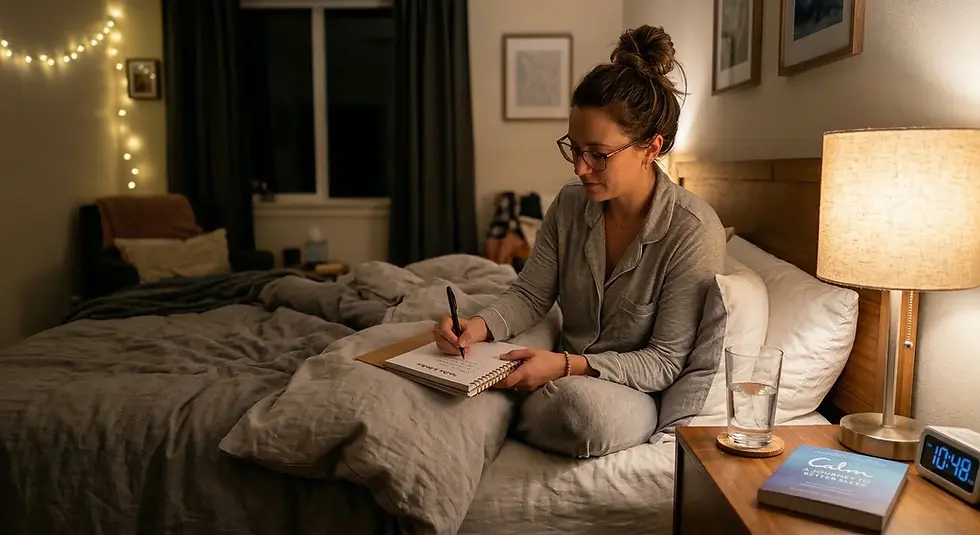
Trying harder to sleep does not work. The nervous system needs a convincing signal that the threat is over, not more pressure to perform.
The most reliable behavioral approach is stimulus control: keeping the bed associated with sleep only, maintaining fixed sleep and wake times regardless of how the previous night went, and cutting off screens 60 minutes before bed. These techniques rebuild the contextual cues that prompt the HPA axis to stand down.
Physical grounding offers a complementary layer. Research shows that earthing during sleep reduces nighttime cortisol and resynchronizes cortisol secretion with the body's natural circadian rhythm. Earthing products that support recovery work by reconnecting the body to the earth's surface charge, which shifts autonomic activity from sympathetic toward parasympathetic. That directional shift is exactly what the body needs to enter and sustain deep sleep.
One more technique worth adding: write down every unfinished task or concern before you turn out the light. The brain's problem-solving loop runs continuously until it believes the problem is handled. A written list signals closure and gives the prefrontal cortex permission to go offline for the night.
What Sleep Patterns Reveal About Your Stress Load

Sleep quality is one of the most direct readouts your body gives you about how well the nervous system is coping. You can push through a stressful stretch feeling functional. Your sleep will show the strain before your conscious awareness does.
The 3 a.m. wake-up is a recognizable signature of HPA axis dysregulation. Cortisol naturally begins rising in the early morning hours to prepare the body for waking. Under chronic stress, that rise happens earlier and more sharply, pulling you out of sleep before you have completed enough recovery cycles. When that pattern becomes consistent, it points to a disrupted cortisol rhythm rather than an isolated run of bad nights.
The productive question to ask is not "why can't I sleep?" It is "what is keeping my cortisol elevated late into the evening?" Answering that honestly, whether it is unresolved pressure, overtraining, an irregular schedule, or poor nutrition, is where meaningful recovery actually starts.
FAQ
Why does stress cause you to wake up in the middle of the night?
Cortisol follows a natural daily curve, rising sharply in the early morning to prepare the body for waking. Chronic stress accelerates and amplifies that rise, which often pulls people out of sleep between 2 and 4 a.m. before enough recovery sleep has accumulated. It is a reliable indicator that the HPA axis has lost its natural rhythm.
How long does it take to recover from sleep deprivation caused by stress?
Recovery sleep helps, but accumulated sleep debt does not resolve after a single long night. Consistent quality sleep over multiple nights is what restores cognitive performance, emotional regulation, and physical recovery capacity. Addressing the underlying stress source alongside sleep habits speeds the process significantly.
Does stress directly affect muscle recovery?
Yes. Most growth hormone secretion occurs during deep slow-wave sleep, which stress-elevated cortisol suppresses. Athletes and active individuals under chronic stress typically see slower recovery, increased soreness, and reduced training adaptations even with consistent effort. Sleep quality carries as much weight as training volume in determining how well the body rebuilds.
Can improving sleep actually reduce stress?
The evidence supports this clearly. Better sleep lowers baseline cortisol, improves emotional regulation, and strengthens resilience to future stressors. Cognitive behavioral therapy for insomnia has been shown to reduce not just sleep problems but general stress severity and depressive symptoms alongside them. Sleep improvement is one of the highest-leverage interventions available for stress recovery.


Comments